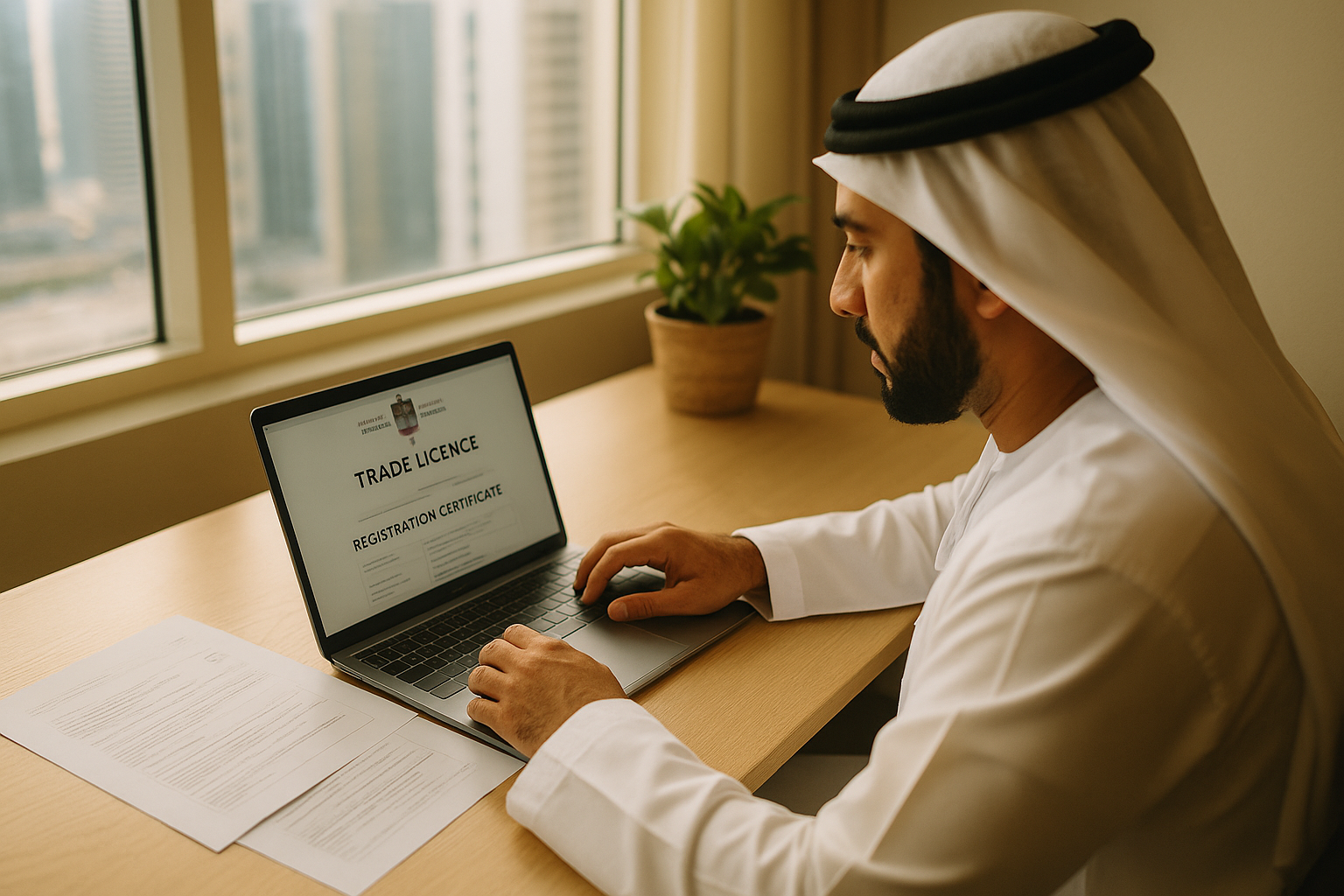
Getting an e-commerce licence in Dubai is the legal prerequisite for any business that sells products or services online in the UAE. Without it, operating an online store or dropshipping operation exposes you to fines and account freezes under Federal Law No. 15 of 2020 on Consumer Protection. Jitendra Business Consultants, with 5,300+ companies formed since 2001, has guided hundreds of online entrepreneurs through the exact registration steps described in this guide. See our full track record at our About page. Whether you are targeting UAE consumers from a mainland entity or setting up a cost-efficient free zone operation, every cost, timeline and document requirement for 2026 is laid out below.
Key Takeaways
- An e-commerce licence is legally required before you can sell goods or services online in the UAE.
- Costs start from around AED 5,500 per year in affordable free zones and rise to AED 15,000 or more for Dubai mainland licences.
- Free zones such as Meydan, SHAMS and IFZA offer the most competitive e-commerce packages for startups.
- The typical registration timeline is 7 to 15 working days from full document submission.
- Since 2021, foreign investors can hold 100% ownership of a mainland e-commerce company in Dubai with no local sponsor required.
- A mainland licence gives direct market access to UAE consumers; a free zone licence may require a local distributor for mainland sales.
Why Dubai Is the Ideal Base for an E-Commerce Business
The UAE e-commerce sector reached USD 6.2 billion in gross merchandise value in 2023, according to the Statista Digital Market Outlook, and is forecast to surpass USD 8 billion by 2026 on the back of 98.4% internet penetration (DataReportal 2024) and near-universal smartphone adoption. Dubai sits at the centre of this growth as the region's logistics and payments hub, served by DHL, FedEx and Aramex regional headquarters and supported by the UAE Central Bank's open-banking infrastructure, which has driven digital payments to 60% of retail transactions.
Tax environment: The UAE levies no personal income tax and applies a 9% corporate tax only on profits above AED 375,000, with small businesses and free zone qualifying entities eligible for full exemption. Exports and international sales attract no VAT. For cross-border e-commerce operations, this structure is materially superior to most European or South Asian alternatives.
Consumer profile: The UAE population is among the world's highest-spending online consumer groups. Average annual e-commerce spend per user is projected at USD 1,485 in 2025 (Statista). Fashion, electronics, beauty and grocery verticals dominate, but demand for specialist goods is growing rapidly across categories.
Logistics advantage: Dubai's Al Maktoum International Airport and Jebel Ali Port together form one of the world's busiest air and sea cargo corridors. Same-day delivery is commercially viable across all seven emirates, a competitive edge that mainland-registered e-commerce companies can leverage for customer acquisition.
Types of E-Commerce Licences in Dubai: Mainland vs Free Zone
Every e-commerce business operating in the UAE requires a trade licence that specifically includes e-commerce or online trading as a listed activity. Two licensing jurisdictions dominate: the Dubai Economic Department (DED) mainland and the various UAE free zones. The choice between them affects your ownership structure, office requirement, bank account options and direct access to the UAE retail market. For a broader overview of how business setup works across both jurisdictions, see our guide to business setup in Dubai.
| Feature |
DED Mainland Licence |
Free Zone Licence |
| Foreign ownership |
100% (since 2021 reforms) |
100% |
| Physical office required |
Yes (flexi-desk accepted) |
No (virtual office available) |
| Direct UAE market sales |
Yes, unrestricted |
Via local agent or distributor |
| Visa allocation |
Based on office space |
Included in package (1 to 6 visas) |
| Typical annual cost |
AED 10,000 to AED 20,000 |
AED 5,500 to AED 15,000 |
| Corporate bank account |
All UAE banks |
Most UAE banks |
Mainland: Businesses intending to sell directly to UAE consumers through their own website, Amazon.ae or Noon.com without an intermediary should opt for a Dubai mainland company formation. The 2021 Foreign Direct Investment reforms removed the 51% local sponsorship requirement for most commercial activities, including e-commerce.
Free zone: Entrepreneurs primarily targeting international markets, or those seeking the lowest possible start-up cost, will find free zone licences more economical. Products shipped from a free zone warehouse to UAE customers are treated as imports and attract 5% VAT on the consumer side, which is manageable for most categories. Most third-party marketplaces in the UAE accept free zone sellers. See our dedicated page on business setup in Dubai free zones for a full jurisdiction comparison.
Step-by-Step: How to Get an E-Commerce Licence in Dubai
1. Define Your E-Commerce Business Activity
The DED and most free zone authorities recognise several distinct activities under the e-commerce umbrella. E-Trading: buying and selling physical goods online. E-Services: selling software, digital products or subscription services. Dropshipping: listed as a sub-activity under e-trading, where you do not hold inventory but fulfil orders via third-party suppliers. Be precise: an incorrect activity code can result in your licence being flagged during renewal or customs clearance.
2. Choose Your Jurisdiction
Select mainland if UAE retail access is your primary goal. Select a free zone (Meydan, SHAMS, IFZA or Dubai CommerCity) if capital efficiency, international shipping or a virtual office suits your model better. If you are unsure, Jitendra Business Consultants offers a free jurisdictional assessment within 24 hours of enquiry.
3. Reserve Your Trade Name
Your company name must not replicate an existing registered entity, must not contain offensive language or references to foreign governments, and for DED licences it must be consistent with your listed activity. DED trade name reservation costs AED 620 and is valid for 60 days. Free zone authorities typically include name reservation in the application fee.
4. Prepare Your Documents
- Passport copies of all shareholders and directors
- UAE residence visa copy (if already resident)
- No Objection Certificate from current employer (if on a UAE employment visa)
- Business plan summary (required by some free zones)
- Proposed company name and activity description
- Emirates ID copy (for UAE residents)
5. Submit Your Application and Pay Fees
For mainland DED: submit through the Dubai Now app or the DED Trader portal. Free zone applications are submitted through the respective free zone's online portal or through a registered agent such as Jitendra Business Consultants. Payment is accepted by bank transfer, card or cheque.
6. Receive Initial Approval and Sign the MOA
Initial approval is typically granted within 3 to 5 working days for free zones and 5 to 10 working days for DED. After initial approval, you sign the Memorandum of Association (MOA) and lease agreement if a physical office is required.
7. Obtain Your Trade Licence
Once the MOA is signed and fees are settled, the trade licence is issued. For free zones, this is often a fully digital document. DED mainland licences are issued as both digital and physical documents.
8. Open a Corporate Bank Account
UAE banks require a valid trade licence, MOA, shareholders' passport copies and proof of address. Average account opening timeline is 2 to 4 weeks depending on the bank's due diligence process. Jitendra Business Consultants maintains relationships with major UAE banks including Emirates NBD, ADCB and RAK Bank that streamline the process for clients.
E-Commerce Licence Costs in Dubai 2026
Costs below are indicative based on current published fee schedules and Jitendra Business Consultants' own transaction data. Annual renewal fees are typically 80 to 90% of the initial setup cost.
| Jurisdiction |
Licence Fee (AED) |
Visa Quota |
Office Requirement |
Total First-Year Cost (AED, approx.) |
| Meydan Free Zone |
5,750 |
1 visa included |
Virtual |
7,500 to 9,000 |
| SHAMS (Sharjah) |
5,500 |
1 visa included |
Virtual |
7,000 to 8,500 |
| IFZA |
12,900 (with 1 visa) |
1 to 6 visas |
Virtual |
13,500 to 16,000 |
| DMCC |
18,000 to 22,000 |
Up to 6 visas |
Physical or flexi-desk |
22,000 to 30,000 |
| Dubai CommerCity |
15,000 to 20,000 |
Up to 5 visas |
Physical |
18,000 to 25,000 |
| DED Mainland |
10,000 to 15,000 |
Based on office size |
Flexi-desk minimum |
15,000 to 22,000 |
Note: Government fees are subject to revision. The figures above are accurate as of October 2026. Additional costs may include establishment card fees (AED 350 to 1,200), immigration file opening (AED 2,000 to 3,500) and visa stamping (AED 2,000 to 3,500 per visa). Jitendra Business Consultants provides a line-itemised cost estimate at no charge before you commit to any package.
Best Free Zones for E-Commerce in Dubai and the UAE 2026
1. Meydan Free Zone
Best for: Solo entrepreneurs and small teams seeking the lowest annual cost. Meydan's e-commerce licence packages start at AED 5,750 and include one visa allocation. The zone has no requirement for a physical office, making it the most capital-efficient entry point for first-time UAE business owners.
2. SHAMS (Sharjah Media City)
Best for: Entrepreneurs seeking the lowest cost entry point. SHAMS is a Sharjah free zone whose licence is accepted by UAE banks and e-commerce platforms including Amazon.ae. Costs start at AED 5,500 for a basic e-commerce licence. Travel time from central Dubai is approximately 30 minutes, and the virtual office package removes any requirement to be physically present at the registered address.
3. IFZA (International Free Zone Authority)
Best for: Businesses that need multiple visas or anticipate rapid team growth. IFZA packages bundle the licence and one visa at AED 12,900 and scale up to six visas. IFZA is located in Dubai Industrial City and issues licences with a comparatively straightforward bank introduction service.
4. Dubai CommerCity
Best for: Established e-commerce operations that require bonded warehouse space, last-mile logistics integration and a dedicated e-commerce ecosystem. Dubai CommerCity is the UAE's first dedicated e-commerce free zone, launched in 2020 by Dubai Airport Free Zone Authority. It offers fulfilment warehouse units, co-working space and direct airside connectivity to Dubai International Airport.
5. DMCC (Dubai Multi Commodities Centre)
Best for: E-commerce businesses that trade in commodities, precious metals or food products where DMCC's specialised licensing categories provide regulatory clarity. DMCC consistently ranks as the world's top free zone (Financial Times fDi Markets, 2023) and its licences carry strong credibility with international banking partners.
FAQs
Can I get an e-commerce licence in Dubai without a physical office?
Yes. The majority of UAE free zones offer virtual office packages that satisfy the address requirement without renting a physical workspace. Mainland DED licences require at minimum a flexi-desk arrangement, which typically costs AED 15,000 to AED 25,000 per year depending on the business centre location.
How long does it take to get an e-commerce licence in Dubai?
Free zone licences are typically issued within 5 to 10 working days of full document submission. DED mainland licences take 7 to 15 working days. Corporate bank account opening adds a further 2 to 4 weeks. Jitendra Business Consultants coordinates all steps simultaneously to compress the overall timeline where possible.
Do I need a UAE residence visa to get an e-commerce licence?
No. Non-resident foreign nationals can obtain a UAE trade licence, including an e-commerce licence, without holding a UAE residence visa. However, you will need to visit the UAE at least once to sign incorporation documents and open a bank account, unless you appoint a power of attorney. The trade licence can itself serve as the basis for a UAE investor or partner visa.
Can I sell on Amazon.ae or Noon.com with a free zone e-commerce licence?
Yes. Both Amazon.ae and Noon.com accept sellers with UAE free zone trade licences, provided the licence lists e-trading or e-commerce as a permitted activity. You will need to register as a seller on each platform separately and provide your trade licence, MOA and bank account details. Some product categories including pharmaceuticals and regulated food items require additional permits regardless of your licence type.
What is the difference between an e-commerce licence and a trading licence in Dubai?
A standard trading licence authorises buying and selling physical goods through conventional retail channels including a physical shop or wholesale distribution. An e-commerce licence specifically authorises online sales channels as the primary selling method. Many DED licences now allow both activities under a combined general trading with e-commerce activity code, which is the recommended option for businesses that may use both channels. Jitendra Business Consultants will advise on the correct activity code combination at no charge during the initial consultation.


 Business Setup